The 3-3-3 Rule for Productivity: How It Works (Free Daily Planner)
The 3-3-3 rule: 3 hours on your most important project, 3 short tasks, 3 maintenance activities. How Oliver Burkeman's method works, a 1-1-1 minimum for hard days and a free printable planner.

Table of Contents
Quick answer: The 3-3-3 rule (or 3-3-3 method) is a daily planning method described by author Oliver Burkeman. Each day you spend 3 hours on your most important project, finish 3 short tasks (urgent to-dos, calls, small jobs) and do 3 maintenance activities (exercise, inbox, journaling, home). Burkeman says the details matter less than the idea: a realistic day with one big block of focus and room to breathe. On hard days, try the 1-1-1 minimum: 1 hour, 1 task, 1 maintenance activity. Free printable planner.
Most to-do lists fail for the same reason: they have 23 items and no idea which one matters. You end the day busy, tired, and no closer to the thing you care about.
The 3-3-3 rule fixes that with a shape instead of a list. One big block for what matters. A few small things to clear. A few things that keep your life running. That's it.
What is the 3-3-3 rule?
The method comes from Oliver Burkeman, the British writer behind Four Thousand Weeks and the newsletter The Imperfectionist. He described it as his own way of structuring a workday, and it spread widely after Inc. covered it in 2022.
| Part | What it is | Examples |
|---|---|---|
| 3 hours | Focused time on your most important current project, with a specific goal for today | Write 1,500 words of the report, finish the design draft, study chapter 4 |
| 3 short tasks | Urgent or "sticky" to-dos that take a few minutes each. Calls and meetings count | Reply to the landlord, book the dentist, send the invoice |
| 3 maintenance activities | Things that keep life and work in order | A walk or workout, clearing the inbox, journaling, laundry |
The important part is the attitude. Burkeman says he doesn't start each day "as if on a tightrope walk", and he encourages people to make up their own version. What matters is the principle, not the exact numbers.
Why the 3-3-3 rule works
It protects one big block. Real progress on a big project rarely happens in 15-minute gaps between messages. Three hours is long enough to get into the work and short enough to do on a normal day.
It is realistic. Three hours of deep focus is a lot. Many people who do creative or thinking work find they can't do much more than three or four hours of real concentration a day. The rule accepts that, so you stop judging yourself against a fantasy 10-hour day.
It gives small tasks a limit. Small tasks expand to fill the day if you let them. Capping them at three means they get done without taking over.
It doesn't forget the rest of your life. The maintenance slot is a reminder that sleep, movement and a clean kitchen are part of a good day too.
It gives you a clear finish line. When the 3-3-3 is done, the day is done. Anything else is a bonus, not a debt.
How to use the 3-3-3 rule (step by step)
1. The night before or first thing: choose your project and today's goal. Not "work on the book" but "draft the opening of chapter 2". Write it in the big box.
2. Put the 3 hours in your calendar. Morning works for many people, but pick when your energy is best. It can be one block or split (for example 2 + 1).
3. Pick 3 short tasks. Include the one you've been avoiding. Do them after the big block, or between parts of it.
4. Pick 3 maintenance activities. Keep them small and specific: "20-minute walk", "inbox to zero", "10 minutes tidying".
5. Stop. When the nine things are done, close the planner. Write one sentence about the day.
The 1-1-1 minimum for hard days
Some days you're ill, travelling, or the kids are home. Instead of skipping the day completely, do the 1-1-1 minimum: 1 hour on your project, 1 short task, 1 maintenance activity. It counts as a full day. In the printable, the 1-1-1 circle is the same size as the 3-3-3 one, because both count.
| Level | Project | Short tasks | Maintenance |
|---|---|---|---|
| 3-3-3 (full) | 3 hours | 3 | 3 |
| 1-1-1 (minimum) | 1 hour | 1 | 1 |
Who is the 3-3-3 rule for?
Freelancers and remote workers who control their own schedule and need structure.
Students who have one big assignment or exam and a pile of small admin.
Writers, designers and makers working on a long project.
Anyone with a side project (use a 1-hour version on workdays and 3-3-3 at weekends).
It's harder if your job is mostly meetings or shift work. In that case, shrink the first block: even 1 protected hour a day on your own project adds up to roughly 20 hours a month.
Try it as a 30-day challenge
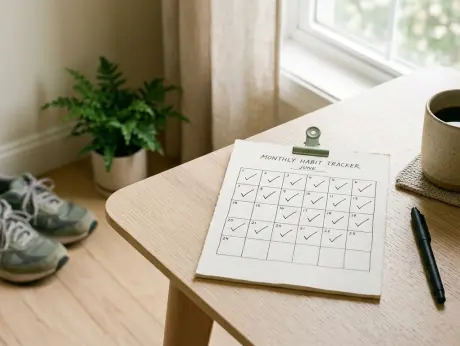
One good day is nice. Thirty days of protected focus can move a project further than you expect. The printable's second page has 30 days: for each one, colour 3-3-3 or 1-1-1 and write which project you moved forward. At the end, add up the hours.
If you want company, start a 30-day 3-3-3 challenge on Harder and post a photo of your planner or your work as proof each day.
Other "3-3-3 rules" (not this one)
If you searched for "3-3-3 rule", you may have seen two other meanings:
The 3-3-3 grounding exercise: name 3 things you see, 3 sounds you hear, and move 3 parts of your body. It's a simple way some people use to bring their attention back to the present. If anxiety is affecting your daily life, talk to a doctor or a mental health professional.
The 3-3-3 rule for rescue dogs: 3 days to decompress, 3 weeks to learn the routine, 3 months to feel at home.
This article is about the productivity method.
Free printable: The 3-3-3 Method Planner
Two pages, free, no signup:
Page 1, My 3-3-3 Day: date and time for your block, the big project box with 1h/2h/3h circles, 3 short tasks, 3 maintenance activities, the 1-1-1 minimum and one sentence about the day. Print one per day.
Page 2, 30 Days of 3-3-3: 30 boxes with 3-3-3 and 1-1-1 circles and a line for the project, plus a review: hours on your main project, what moved forward, what you'll keep, change or drop.
FAQ
What is the 3-3-3 rule for productivity? It's a daily plan described by Oliver Burkeman: 3 hours on your most important project, 3 short tasks and 3 maintenance activities.
Who created the 3-3-3 method? Author Oliver Burkeman described it in his newsletter The Imperfectionist. He presents it as his own approach and encourages people to adapt it.
Do the 3 hours have to be in one block? No. One block is ideal for deep work, but 2 + 1 or three separate hours also work. What matters is that the time is protected and goes to one project.
What counts as a maintenance activity? Anything that keeps your life or work running: exercise, a walk, inbox, journaling, cooking, tidying, admin, sleep routines.
What if I can't do 3 hours a day? Use the 1-1-1 minimum (1 hour, 1 task, 1 maintenance activity) or scale the first block to what you have. One protected hour a day is still about 20 hours a month.
Is the 3-3-3 rule the same as the anxiety 3-3-3 rule? No. The grounding exercise (3 things you see, 3 sounds, 3 body parts) is a different technique with the same name.
How is 3-3-3 different from time blocking? Time blocking plans every hour of the day. The 3-3-3 rule only fixes nine things and leaves the rest of the day open.
Key takeaways
3 hours, 3 short tasks, 3 maintenance activities. That's a full day.
The method comes from Oliver Burkeman, who says the principle matters more than the numbers.
Protect one big block for your most important project.
On hard days, the 1-1-1 minimum counts.
Try it for 30 days and count the hours you gave to what matters.
Sources
Stillman, J. (2022, March 23). Steal this best-selling author's 3-3-3 method for managing your time. Inc. inc.com
Burkeman, O. The Imperfectionist (newsletter), where the 3-3-3 method was first described.
Burkeman, O. (2021). Four Thousand Weeks: Time Management for Mortals. Farrar, Straus and Giroux.
Updated