Vision Board 2027: How to Make One That Actually Leads to Action (Free Template)
How to make a 2027 vision board that works: why pictures of the finish line aren't enough, what research says about picturing the process, 7 steps, ideas for every life area and a free printable template with one challenge a month.
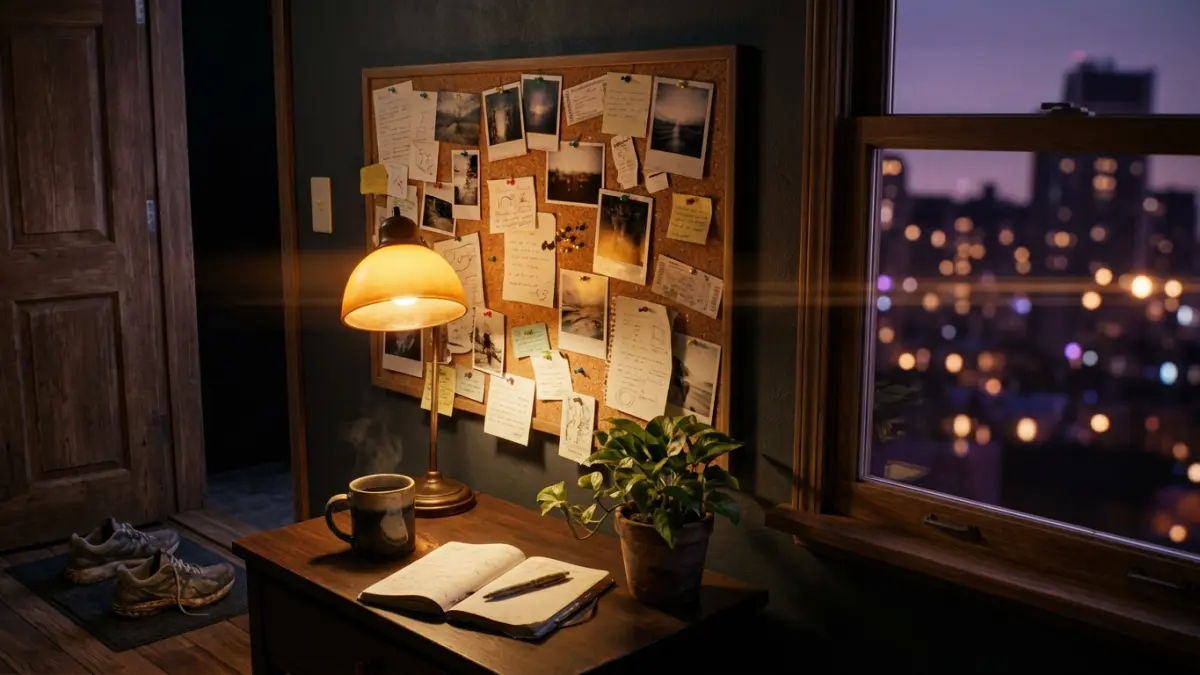
Table of Contents
Quick answer: A vision board is a collage of pictures and words that show what you want from the year. On its own it's a nice reminder, but research suggests that picturing only the result can lower your energy to act, while picturing the process (the steps) helps. So make an action vision board: for each of 4–6 life areas, add a picture, what you want, one weekly action and a first challenge with a finish line. Then turn the board into a calendar with one challenge a month, and check it every three months. Free printable template.
Every December, Pinterest fills up with vision boards: beach houses, perfect kitchens, running medals, "2027 is my year" in gold letters.
And every March, most of those boards are still on the wall, a little faded, with nothing on them any closer than in January.
The board isn't the problem. The problem is that most boards only show the finish line. This guide shows you how to make one that shows the path too.
Do vision boards work?
There's very little research on vision boards themselves. But there's good research on what a vision board does to your brain: it makes you imagine your future. And how you imagine it matters a lot.
Picturing only the dream can make you do less. Psychologists Heather Barry Kappes and Gabriele Oettingen ran four experiments in which people imagined an ideal future. Afterwards they had less energy than people who imagined the future more realistically (Kappes and Oettingen, 2011). Feeling good about the result can feel a little like having achieved it.
Picturing the process helps you act. In a classic study, students preparing for an exam spent a few minutes a day for about a week imagining either getting a great grade or the process of studying: where, when and how. The students who pictured the process studied more, felt less anxious and got better grades (Pham and Taylor, 1999).
Dreaming plus planning works best. Oettingen's research on WOOP (Wish, Outcome, Obstacle, Plan) shows that when people picture their wish, then the obstacle in their way, and then make an if-then plan, they're more likely to act on it (Oettingen and Reininger, 2016).
So yes, a vision board can help, if it shows more than the finish line. Put the steps on the board, not only the prize.
Classic board vs. action board
| Classic vision board | Action vision board |
|---|---|
| A medal from a marathon | Running shoes by the door on a dark morning |
| A perfect, tidy living room | One clear drawer, one shelf at a time |
| A stack of money | A savings jar and "10% of every payment" |
| A published book | A notebook, a coffee and "300 words before work" |
| "2027 is my year" | Your word for 2027 + 12 monthly challenges |
How to make your 2027 vision board in 7 steps
1. Look back before you look forward
Spend 20 minutes on 2026: what went well, what didn't, what you want more of. Our Year in Review: 25 questions are made for this.
2. Choose 4–6 life areas
Not ten. Pick the areas that matter most this year. Common ones: health and movement, work and career, money, home, relationships and family, learning, creativity, rest and fun.
3. Choose your word for 2027
One word that sums up the year you want: calm, brave, finish, strong, home. Put it in the middle or at the top. (If you did our winter solstice ritual, you already have it.)
4. For each area, find one picture of the process
Look for images of doing, not only of having: shoes on a rainy morning, a notebook on a kitchen table, a vegetable box, a calendar with crosses. One outcome picture is fine, but put a process picture next to it.
5. Under each picture, write three things
What I want: "Run a 10K in October."
What I'll do every week: "Run three times a week, even slowly."
My first challenge: "Couch to 5K, 9 weeks."
The template has space for exactly this.
6. Add your obstacles and if-then plans
What usually stops you? Write it, and write a plan: "If it's raining, then I do a 20-minute workout at home." One or two are enough.
7. Turn the board into a calendar
This is the step most boards are missing. Give each month one challenge from your board. January: Dry January. February: a reading challenge. March: Couch to 5K. Twelve finish lines instead of one giant year. Then put the board somewhere you'll see it every day and set four check-in dates: the end of March, June, September and December.
Vision board ideas for 2027, by area
| Area | Process picture | Weekly action | First challenge |
|---|---|---|---|
| Health | Shoes by the door | Walk or run 3 times a week | Couch to 5K or Japanese walking |
| Drink less | A fancy alcohol-free drink | Alcohol-free weekdays | Dry January |
| Home | One clear drawer | 15 minutes of tidying, 4 times a week | 31-day declutter |
| Focus | A phone face down | A phone-free first hour | 7-day digital declutter |
| Work | A desk with one open notebook | 3 hours on the most important project | The 3-3-3 rule |
| Creativity | Paint, yarn or a sketchbook | A little every day | One project in 30 days |
| Reading | A book and a blanket | 10 minutes a night | Cozy Reading |
| Mind | A journal page | 3 good things a day | 30 days of gratitude |
Challenge links: Couch to 5K · Japanese walking · Dry January · 31-day declutter · 7-day digital declutter · The 3-3-3 rule · One project in 30 days · Cozy Reading · 30 days of gratitude
Paper or digital?
Paper: cut out pictures from old magazines, print photos, draw, use stickers. It's slower and more personal, and it's easy to put on a wall or the fridge.
Digital: a secret Pinterest board, a collage in a design app, or your phone's lock screen. You'll see it many times a day.
Best of both: a paper board on the wall plus a photo of it as your phone wallpaper. Whatever you choose, keep the actions and challenges on paper (the template's page 2), where you can tick them off.
Host a vision board evening
Making boards with friends is more fun and more useful: everyone says their word and their first challenge out loud. Bring magazines, scissors, glue, snacks. At the end, agree on one thing: start your first challenges on the same day and check in with each other at the end of the month.
Pair it with the 3-6-9 method
Pick one tile from your board and make it your first 21 days. Write the intention 3, 6 and 9 times a day, and do your weekly action. Our 3-6-9 method with action has a free journal for it.
5 mistakes that make vision boards fail
1. Only finish-line pictures. Add the process.
2. Too many goals. Six areas maximum, one challenge at a time.
3. Hidden in a drawer. Put it where you'll see it every day.
4. No dates. Without a calendar it's a wish list. Give each month a challenge.
5. Never updated. Check it every three months. Changing your board is part of the plan, not a failure.
Free printable: 2027 Vision Board Template
Two pages, free, no signup:
Page 1, My 2027 Vision Board: your word for 2027 and six tiles, each with space for a picture or words, the area, what you want, your weekly action and your first challenge with its length.
Page 2, One Challenge a Month: 12 months with a challenge line and a "Finished" circle, plus space for if-then plans and your four check-in dates.
Want a bigger board? Print page 1 on A3, or use it as a guide for a poster-sized board.
From board to proof on Harder
On Harder, now on iOS and the web, every challenge from your board can become a real challenge with daily steps, a minimum and a finish line. Post a small proof each day, and at the end of the month share the finished challenge. By December 2027 you won't just have a board. You'll have twelve finish lines.
FAQ
How do I make a vision board for 2027? Look back at 2026, choose 4–6 life areas, pick a word for the year, find one picture of the process for each area, write what you want, a weekly action and a first challenge, add if-then plans, then give each month one challenge.
Do vision boards really work? There's little research on vision boards themselves. Research on imagining the future shows that picturing only the result can lower your energy to act, while picturing the process and planning helps. A board works best when it includes actions and dates.
What should I put on a vision board? Pictures of what you want and pictures of the steps to get there, your word for the year, and for each area one weekly action and one first challenge.
What are the categories of a vision board? Common ones are health, work, money, home, relationships, learning, creativity and rest. Choose four to six.
Where should I put my vision board? Somewhere you see it every day: by your desk, on the fridge, inside a wardrobe door, or as your phone wallpaper.
When should I make a vision board? Between Christmas and New Year is popular, but any fresh start works: your birthday, the first day of a month or the start of a season.
How often should I update my vision board? Check it every three months. Keep what still matters, change what doesn't, and choose the next challenges.
Key takeaways
Picturing only the result can lower your energy. Picturing the process helps you act.
Make an action board: picture, what I want, weekly action, first challenge.
4–6 areas, one word for 2027.
Turn the board into 12 monthly challenges and check it every three months.
Put it where you see it every day.
Sources
Kappes, H. B., & Oettingen, G. (2011). Positive fantasies about idealized futures sap energy. Journal of Experimental Social Psychology, 47(4), 719–729.
Pham, L. B., & Taylor, S. E. (1999). From thought to action: Effects of process- versus outcome-based mental simulations on performance. Personality and Social Psychology Bulletin, 25(2), 250–260.
Oettingen, G., & Reininger, K. M. (2016). The power of prospection: Mental contrasting and behavior change. Social and Personality Psychology Compass, 10(11), 591–604.